Firstly, let me fess up: clearly my posting schedule needs some attention and for that I am sorry. With that out of the way, on to bigger and brighter things - namely beer! Beer wonderful beer to be precise! There is an old joke about drinkers "owning shares in the brewery", but recently via a very slick marketing campaign Moa launched "own a brewery".
Feelings about slick marketing campaigns aside, if there ever was a case for putting your money where your mouth is, it would have to be this! Moa make splendid beer, quite outstanding beer in fact, and what's more, they make a whole range of it. I've written about Moa here and their wonderful beer here so with news of their IPO fresh from the tap (excuse the bad puns!), it seemed like the perfect time to go back and review another of their incredible brews.
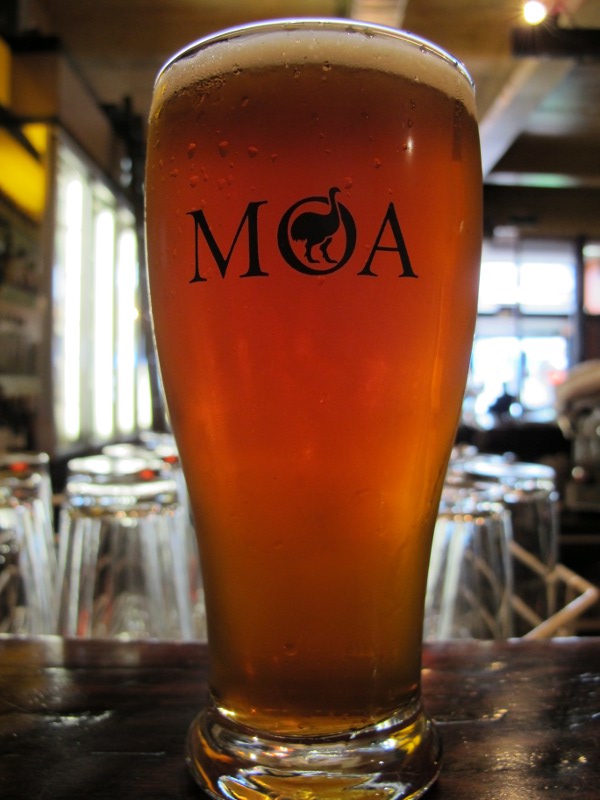
Moa 5 Hop is touted as a Winter Ale but this delicious brew would be fantastic any time as far as I'm concerned. Made in the ESB style, it has a lovely amber, almost red colour. Floral and herbaceous on the nose as well as a bit spicy, it almost reminds me of Gingerbread.
Credit goes to the fantastic beer blogger Philcook for the image.
The taste? Utterly delicious, sweet around the edges marks this as unmistakably Moa. Complex malt base, perfectly balanced bitterness and flavourful hops giving a distinct kick on the finish. A great example of craft beer working to style but with its own personality. A great brew for sure!
Dedicated to the celebration of beer, and by extension other manly pursuits. Drink responsibly.
Showing posts with label Ale. Show all posts
Thursday, October 18, 2012
Wednesday, August 29, 2012
Homebrew Review: Highetbrau
Good beer comes in many shapes and sizes, and just like a lot of things making your own can be even more rewarding and enjoyable than the commercial stuff. Highetbrau have been in the beer making game for a couple of years now - starting like so many homebrewers with pre-hopped malt and adding sugar. But good beer doesn't just mix itself up like cordial and brewer Jason Highet quickly moved on to crafting his own ales. And what wonderful ales they are!
It today's world of mass produced lagers and commercial craft beers it's easy to forget that the technical process of brewing beer is relatively simple. Boil malt, add hops, pitch yeast and wait. The real trick is in the detail. Highetbrau follow that simple ethos and it's the attention to detail where Highetbrau beer shines. Every brewer knows that cleanliness is next to beeriness and Jason is logical and methodical when it comes to preparing both his beer and his equipment.
You can find out more about Jason's philosophy over at booze bros, but for now I'll just straight into the good stuff. Today I tried 3 beers, Amberbier, Feijoabier and Darkbier.
First the Amberbier. Well it lives up to it's name and it's certainly Amber, as well as being impressively clear for a homebrew. Being an Amber Ale there is tremendous breadth in what the beer might be like, but there's really only one way to find out... There are lovely nutty and caramel aroma's with hints of citrus. The taste is full of caramel and grains with the distinctive bitter sticklebract hops finish lingering. Delicious and very easy drinking!
Then it was time for the Feijoabier. Very pale and tantalisingly cloudy. Clearly it's aroma is of feijoa but what's impressive here is that it smells like it was picked yesterday, fresh and sweet smelling. On the taste, the first thing you notice is light smooth texture with wonderful sparkling effervescence, then comes the feijoa taste which reveals a nice and light malty finish. Incredibly refreshing and this makes me hunger for warm sunny summer afternoons.
Then we meet the Darkbier. The aroma is classic porter - chocolate malt and coffee. In the mouth it definitely has the lighter body of a porter but quite surprisingly the rich depth of flavour that you might usually associate with a bigger stout. Subtle and effective hints of the chocolate malts and a lovely dry finish.
All up, these beers are fantastic. They all have unique characteristics both reassuring of style and showing the spirit of experimentation that many craft brewers strive for.
Monday, June 25, 2012
Slam Dunkel
Water, Barley, Hops, Yeast. The ingredients list for beer is short but the variety that comes from those four things is vast and inspired. We are told that to make great beer we need the freshest ingredients, the best ingredients. The best beers much like the best meals, are made with attention to these details.
In order to preserve the purity of their beers the Reinheitsgebot was established in one of the birthplaces of beer, Bravaria in 1516. Reinheitsgebot, or "German Beer Purity Law" for short, initially excluded yeast, because it wasn't until after Louis Pasteur revealed the role of micro-organisms in fermentation in the 1800's that yeast was revealed to be an essential part of beer.
German Beer Purity Law, or at least the tradition of it has inspired beer makers ever since and particularly German/Bravarian beermakers which brings us to today's beer: Flensburger Brauerei Dunkel.
Right here we have a classic German Dunkel, which is just any mid strength beer made with darker roasted malts. Made in the classic pop-top bottle giving it a real european feel the beer is a warm reddish brown and much warmer in colour than many northern European Dark Ales. Wonderfully deep aroma with cereal and dough. The taste is rich warm and nutty with a nice light carbonation, a very pronounced cereal with a lingering bitterness.
More balanced than many of it's English counterparts for sure, and the colour is just so inviting on a cool winter's evening.
It's sparked some interest on the role of yeast in certain beers which I'll look at another time.
In order to preserve the purity of their beers the Reinheitsgebot was established in one of the birthplaces of beer, Bravaria in 1516. Reinheitsgebot, or "German Beer Purity Law" for short, initially excluded yeast, because it wasn't until after Louis Pasteur revealed the role of micro-organisms in fermentation in the 1800's that yeast was revealed to be an essential part of beer.
German Beer Purity Law, or at least the tradition of it has inspired beer makers ever since and particularly German/Bravarian beermakers which brings us to today's beer: Flensburger Brauerei Dunkel.
Right here we have a classic German Dunkel, which is just any mid strength beer made with darker roasted malts. Made in the classic pop-top bottle giving it a real european feel the beer is a warm reddish brown and much warmer in colour than many northern European Dark Ales. Wonderfully deep aroma with cereal and dough. The taste is rich warm and nutty with a nice light carbonation, a very pronounced cereal with a lingering bitterness.
More balanced than many of it's English counterparts for sure, and the colour is just so inviting on a cool winter's evening.
It's sparked some interest on the role of yeast in certain beers which I'll look at another time.
Labels:
Ale,
Beer,
Dark Ale,
Dunkel,
Flensburger,
German,
Hops,
Malt,
Reinheitsgebot,
Yeast
Monday, May 21, 2012
Hopping Hare and the fine art of correct serving temperature.
I was first turned onto Badger Ales while living in London - available at most of the supermarkets and many pubs their extensive and reliable range quickly becoming a go to brand for great beer. Brewed in Dorset since the late 1700's Badger championed a back to basics approach that has since become popular with craft brewers worldwide. Combining the traditional Malt, Hops, Yeast and Water into delicious beer seems to come naturally to them and their approach earned the attention of Hugh "River cottage" Fearnley-Whittingstall who joined forces for a special brew.
Badger are probably most well known for Tanglefoot or Fursty Ferret, both good examples of English Ales, but this cool autumn evening it was Hopping Hare that caught my eye. Up at Speakers Corner in Browns Bay there is a good range of beers, including a couple of Fullers range on tap. The pub is decent, and probably only one of a few around New Zealand that capture the English pub feel properly (possibly because it's run by ex-pats!).
Anyway, having warmed up on a London Porter it seemed that the new Badger bottles were getting some attention and ever inquisitive I decided to check out the offering for myself.
The verdict? Pretty good, if slightly misleading. For a beer calling itself highly hopped I thought it was more balanced and malty, but perhaps I've had too many IPA's lately? This isn't to say it's an unpleasant beer, quite the opposite: there are some very nice notes of fruit and bitterness, even if they're more subtle in the mix but there is also a lovely bread aroma in there. The flavour is very nice, rewarding and full with a rather enjoyable effervescent hops fruitiness at the finish. Despite being an English pub, in typical New Zealand fashion the beer was served just a touch above freezing, and it was fellow beer-enjoyer Matt that noted it would be better at room temperature.
As luck would have it I was in a room, so it was only a matter of time before I was able to enjoy even more of those delicious rich malty flavours in the manner which their maker intended.
Yes, I know that Lager needs to be cold. But Ale isn't Lager, it's about letting the subtle flavours come out rather than refining them to a crisp perfection. When too cold Hopping Hare fell slightly short of expectations, but came to life when allowed to warm.
There's a lesson here, for optimum enjoyment (and that's what it's all about, right?) it's best to serve appropriately. You wouldn't have Fish and Chips cold? Yes, we've all heard (or experienced) Ale's poorly cellered: flat, warm, bad. But the right temperature can bring a beer to life!
Badger are probably most well known for Tanglefoot or Fursty Ferret, both good examples of English Ales, but this cool autumn evening it was Hopping Hare that caught my eye. Up at Speakers Corner in Browns Bay there is a good range of beers, including a couple of Fullers range on tap. The pub is decent, and probably only one of a few around New Zealand that capture the English pub feel properly (possibly because it's run by ex-pats!).
Anyway, having warmed up on a London Porter it seemed that the new Badger bottles were getting some attention and ever inquisitive I decided to check out the offering for myself.
The verdict? Pretty good, if slightly misleading. For a beer calling itself highly hopped I thought it was more balanced and malty, but perhaps I've had too many IPA's lately? This isn't to say it's an unpleasant beer, quite the opposite: there are some very nice notes of fruit and bitterness, even if they're more subtle in the mix but there is also a lovely bread aroma in there. The flavour is very nice, rewarding and full with a rather enjoyable effervescent hops fruitiness at the finish. Despite being an English pub, in typical New Zealand fashion the beer was served just a touch above freezing, and it was fellow beer-enjoyer Matt that noted it would be better at room temperature.
As luck would have it I was in a room, so it was only a matter of time before I was able to enjoy even more of those delicious rich malty flavours in the manner which their maker intended.
Yes, I know that Lager needs to be cold. But Ale isn't Lager, it's about letting the subtle flavours come out rather than refining them to a crisp perfection. When too cold Hopping Hare fell slightly short of expectations, but came to life when allowed to warm.
There's a lesson here, for optimum enjoyment (and that's what it's all about, right?) it's best to serve appropriately. You wouldn't have Fish and Chips cold? Yes, we've all heard (or experienced) Ale's poorly cellered: flat, warm, bad. But the right temperature can bring a beer to life!
Wednesday, April 25, 2012
No, It's not salty, but it is Zythos.
Epic Beer make a lot of incredible beer. They have stood as beacons of great beer for a fair while now, and just keep getting more and more inventive. They have informally specialised in IPA - Indian Pale Ale, a fact for which I completely understand, and am very grateful for. Armageddon IPA has been turning heads for a while now with it's potent hoppiness, and the latest in that line of thinking (or drinking) is Zythos IPA.
There is apparently a hop shortage (but don't panic). Back in 2006 a glut in the US hops market forced prices down, and in response farmers pulled up their hops in favour of more profitable crops. The saving grace is that this primarily effected US Hops varieties. It's a cycle of boom and bust, and pretty much a classic example of supply/demand economics. Things were looking up in 2009 when Epic started making Hop Zombie, a tribute to the big American Pale Ales and American IPA styles. But (gasp) disaster struck again and we're back into the "shortage" part of the cycle.
This presented an obvious problem in the production of Hop Zombie. Not to be dissuaded (and obviously happy to craft up a hoppy beer at a moment's notice) - head brewer Luke Nicholas whipped up Zythos using some hybrid hops and some good old fashioned kiwi ingenuity.
The result is spectacular.
Much has been made of the name - no it's not the Greek name for the salted Egyptian brew. Much has also been speculated on the exact hybrid and blend of hops that goes into this masterpiece. I don't know that (though I would love to hear!).
What I can say is that this forging of flavours is truly something to get your lips around.
Satisfying deep red to amber in colour with a lovely light amber head, it's easy on the eye but offers some surprised for the palette. The nose is all warm citrus, there is something herbaceous almost christmassy about it, and there might just be a pinch of fresh bread in there too.
The taste is crisp and bitter up front, softening to rich fruits and citrus and maybe a hint of woodiness. These are all incredible things. It tastes like so much more than the sum of it's parts, I almost to find out that this is more than just the usual combination of malt, hops and water. It has a lively carbonation with light bubbles and a full malty mouth feel.
It's good. Bloody good. It might just be better than Armageddon if that's even possible. I have heard that this is in fairly short supply, so I'd get out and get some quick if I were you...
Thursday, March 22, 2012
Do you need glasses?
Beer Glasses are a big thing for me, so I'm going to talk about why people use beer glasses, the types of beer glasses, the best beer glasses for different beer styles and a whole lot of other glassey goodness.
We all know the line when someone hands you a bottle beer of beer and asks if you want a glass: "it already comes in one". And to a large extent, with non-distinct lagers that's a fair statement to make. In fact one of the great joy's of beer is it's portability - going to the beach? Pack a couple of cool brews and you're set.
But there's a counter argument - a glass allows you to enjoy the beer more. You can experience it's colour, it's effervescence (I'm not exactly comfortable with that word in describing a beer), it's head and allows you to get a better handle on it's aroma. If you're taking export gold's to a party it hardly matters, but if you want to get the most out of your limited edition craft ale - or even your better than average lager the right glass can make a good beer even better. If a beer glass can make even a ho-hum lager halfway decent, imagine what it can do for that special IPA you've had tucked away for months!
In the great beer brewing parts of Europe, many beers have their own glass to enhance the flavour and aroma for us humble beer drinkers.
There are a boatload of sizes and regional types of glasses that I wont go into here, but broadly speaking these are the typical beer glasses as recommended by such beer alumni as Michael "Beer Hunter" Jackson.
Pilsner/Lager Glass
Tall to reveal colour and carbonation, and with a taper to enhance head retention.Like the name on the box says, perfect for Pilsners and Lagers
Snifter/Goblet
For aromatic beers like IPA or "Big" beers for sipping like doppelbock. These are large, stemmed, bowl shaped. I throw beer flutes in this group mainly for simplicity.
Pint Glass/Mug
The classic, versatile beer glass, suits most styles, but atypically English.A clever wee feature is that these can actually enhance the carbonation of a beer.
Most importantly, a beer glass allows you to enjoy another fine aspect of a beer: the pour.
Getting more out of your beer is an easy sell, and making a run of the mill Ale or Lager taste like something halfway decent can't be bad either. A glass that you can get your nose into, that you can see the beer and experience it's colour and fizz.
Thursday, March 15, 2012
A Tale of Pale Ale
Pale Ale is one of the most popular Beer styles, produced using predominantly light (or pale, if you will) malts and brewed with top-fermenting yeasts. It's one of the most traditionally innovative styles of Beer and Pale Ale and to this day brewers are making winning Pale Ale's in a variety of ways.
Typically a Pale Ale does indeed derive it's name from it's light hue - before Lagers, it was the lightest beer style. it came about because roasting malts is a tricky business, especially in the pre industrial days when brewers relied on fire kilns to do their roasting. As you can imagine, roasting little bits of barley over open flame produced more than a little darkening of the malts - and hence at the time (this is the late 1700's) Ales were usually of the darker variety.
Anyway, today a Pale Ale is considered to be golden amber through to copper in colour, leaving plenty of room for brewers to experiment with malts to obtain subtle sweetening and complexity of malt flavours. Pale Ale is a broadly encompassing style of beer, including English Bitter, American Pale Ale, Irish Red, Blond and many more, but today I'm going to look at two.
I'll talk about Boundary Road brewery later, but for now lets consider the merits of this beer. Because of the flexibility of the style there is no one Hops profile typical to Pale Ale, and being a man who enjoys a lot of Hops in my beer, The Flying Fortress Pale Ale does not disappoint. There's a certain distinctive tangy frutiness to the NZ varieties of Hops, and Flying Fortress is rich with hoppy goodness. A lush but not overwhelming mix of Pacific Jade and Motueka provide wonderful fruity aroma and just the right amount of bitterness. What most impresses me with Flying Fortress is the beautiful mouth feel - delicate carbonation that could almost pass for bottle conditioning and an impressive almost creamy texture. Boundry Road are quickly establishing themselves as winners in the rapidly growing craft beer market and Flying Fortress is the cornerstone that grounds their excellent range.
I'm not particularly familiar with the craft beer market over the ditch (something that I plan on rectifying as soon as possible) but a little Pale Ale from Victoria is making inroads here. Matilda Bay have made a great Pale Ale with a strange name: Fat Yak.
It's a great contrast to Flying Fortress - this is made in the American Pale Ale style, making it more golden than amber, but is liberally hopped with the American staple: Cascase, with a little Nelson Sauvin for added depth. It's good - delightfully fruity and crisp on the palette, this beer practically screams "Summer Afternoon".
These two Pale Ale's offer a fantastic exercise in hops comparison - both are boldly hopped in different ways. Both are excellent. Enjoy!
Typically a Pale Ale does indeed derive it's name from it's light hue - before Lagers, it was the lightest beer style. it came about because roasting malts is a tricky business, especially in the pre industrial days when brewers relied on fire kilns to do their roasting. As you can imagine, roasting little bits of barley over open flame produced more than a little darkening of the malts - and hence at the time (this is the late 1700's) Ales were usually of the darker variety.
Anyway, today a Pale Ale is considered to be golden amber through to copper in colour, leaving plenty of room for brewers to experiment with malts to obtain subtle sweetening and complexity of malt flavours. Pale Ale is a broadly encompassing style of beer, including English Bitter, American Pale Ale, Irish Red, Blond and many more, but today I'm going to look at two.
I'll talk about Boundary Road brewery later, but for now lets consider the merits of this beer. Because of the flexibility of the style there is no one Hops profile typical to Pale Ale, and being a man who enjoys a lot of Hops in my beer, The Flying Fortress Pale Ale does not disappoint. There's a certain distinctive tangy frutiness to the NZ varieties of Hops, and Flying Fortress is rich with hoppy goodness. A lush but not overwhelming mix of Pacific Jade and Motueka provide wonderful fruity aroma and just the right amount of bitterness. What most impresses me with Flying Fortress is the beautiful mouth feel - delicate carbonation that could almost pass for bottle conditioning and an impressive almost creamy texture. Boundry Road are quickly establishing themselves as winners in the rapidly growing craft beer market and Flying Fortress is the cornerstone that grounds their excellent range.
I'm not particularly familiar with the craft beer market over the ditch (something that I plan on rectifying as soon as possible) but a little Pale Ale from Victoria is making inroads here. Matilda Bay have made a great Pale Ale with a strange name: Fat Yak.
It's a great contrast to Flying Fortress - this is made in the American Pale Ale style, making it more golden than amber, but is liberally hopped with the American staple: Cascase, with a little Nelson Sauvin for added depth. It's good - delightfully fruity and crisp on the palette, this beer practically screams "Summer Afternoon".
These two Pale Ale's offer a fantastic exercise in hops comparison - both are boldly hopped in different ways. Both are excellent. Enjoy!
Monday, March 5, 2012
The IPA Debate
I've been thinking about Indian Pale Ales - so it's timely that the very nice people at Boundry Road Breweries are about to release an IPA and are asking for tasters. You can get in on this by answering a few simple IPA questions here.
But I digress...
IPA's were famously developed because regular ale wasn't lasting the long trip from Great Britain to India in the 1800's. Brewers made the brew stronger and added more hops to preserve the beer and hide any off flavours picked up in the long voyage fraught with poor cask storage conditions. When it arrived it was watered down for the enlisted men (though officers were still allowed the higher strength)... or so the story goes. Demand in the homeland grew shortly thereafter and the IPA legacy was born.
So if we take the style to be full strength, pale ale that's both bitter and aromatic with hops we come to Fullers IPA.
Definitely full and hoppy, this is my flagstone IPA. Lovely body, beautiful fruit aroma, bottle conditioned. The only thing that's missing is good head (pun only partway intended). This is fantastic drinking.
So what ISN'T and IPA? Well, Tui for one. Lacking any notable hops, sweet instead of bitter and brewed as a Lager, Tui has no place calling itself an IPA. Tui is in fact, a good example of a New Zealand Draught - and Draught is the topic of an future post (and thanks to Randolf von Stagg for the suggestion).
There are of course in this brave new world of craft breweries, many fine examples of great IPA's - both classic and modern. Dunedin crowd Emerson's 1812 is a good traditional IPA, Epic (who can do no wrong) make a pretty stunning Armageddon IPA. I've yet to taste the open source beer from Yeastie Boys - Digital IPA, but judging by the Hop's bill that's going to be a mighty, mighty interesting experience... if anyone knows a shop or pub in Auckland selling it I'd be one happy, hoppy beer drinker.
But I digress...
IPA's were famously developed because regular ale wasn't lasting the long trip from Great Britain to India in the 1800's. Brewers made the brew stronger and added more hops to preserve the beer and hide any off flavours picked up in the long voyage fraught with poor cask storage conditions. When it arrived it was watered down for the enlisted men (though officers were still allowed the higher strength)... or so the story goes. Demand in the homeland grew shortly thereafter and the IPA legacy was born.
So if we take the style to be full strength, pale ale that's both bitter and aromatic with hops we come to Fullers IPA.
Definitely full and hoppy, this is my flagstone IPA. Lovely body, beautiful fruit aroma, bottle conditioned. The only thing that's missing is good head (pun only partway intended). This is fantastic drinking.
So what ISN'T and IPA? Well, Tui for one. Lacking any notable hops, sweet instead of bitter and brewed as a Lager, Tui has no place calling itself an IPA. Tui is in fact, a good example of a New Zealand Draught - and Draught is the topic of an future post (and thanks to Randolf von Stagg for the suggestion).
There are of course in this brave new world of craft breweries, many fine examples of great IPA's - both classic and modern. Dunedin crowd Emerson's 1812 is a good traditional IPA, Epic (who can do no wrong) make a pretty stunning Armageddon IPA. I've yet to taste the open source beer from Yeastie Boys - Digital IPA, but judging by the Hop's bill that's going to be a mighty, mighty interesting experience... if anyone knows a shop or pub in Auckland selling it I'd be one happy, hoppy beer drinker.
Monday, February 27, 2012
Coopers Sparkling Ale - A real Southern Hemisphere Ale?
First international beer off the ranks - I specifically hunted this out because 1. It was on special at the supermarket and 2. I'm planning on brewing a batch of this in the near future.
Anyway, I have a small issue... a pet peeve if you want to call it that. Although we have many, many wonderful beers here in Aotearoa, we have a tendency to make beer that's not true to style. This isn't to say that we don't have some wonderful examples of craft beers that are true to form or an exciting evolution of an accepted style. It's a reflection of the market - we like Lagers and Hoppy Pilsners; therefore that's what the brewers make.
Australia too has a slightly unfortunate habit of doing the same - the "mainstream" breweries in both markets rightfully cater to the tastes of the public. And dammit the public want lager!
Forgiving the local pallet and forgiving the flavour of the ingredients... but some beers (I'm looking at you Tui and Speights) even claim to be Ale's when they are in fact Lagers. But beer is beer and beer is good.
So it was with a pleasant surprise that I popped open my Coopers Sparkling Ale and smelt the delicious aroma of top fermentation and bittering hops.
A real ale! Probably a little light in bitterness for the English and maybe lacking the complexity of a Belgian... but an ale none the less. In fact it's delicate flavour and effervescent sparkle make this a great companion to the southern summer. Coopers Sparkling Ale is a breath of fresh Ale in a Lager world - and from a mainstream brewer none-the-less!
As a note to beermaker's in our corner of the world - it's ok to make a traditional Ale, Bitter, Bock, Helles or Weizen. With the current increase in craft brewing I hope to see a lot more of these and more, but for now it's nice to know that there is a delicious alternative to lager at hand.
Anyway, I have a small issue... a pet peeve if you want to call it that. Although we have many, many wonderful beers here in Aotearoa, we have a tendency to make beer that's not true to style. This isn't to say that we don't have some wonderful examples of craft beers that are true to form or an exciting evolution of an accepted style. It's a reflection of the market - we like Lagers and Hoppy Pilsners; therefore that's what the brewers make.
Australia too has a slightly unfortunate habit of doing the same - the "mainstream" breweries in both markets rightfully cater to the tastes of the public. And dammit the public want lager!
Forgiving the local pallet and forgiving the flavour of the ingredients... but some beers (I'm looking at you Tui and Speights) even claim to be Ale's when they are in fact Lagers. But beer is beer and beer is good.
So it was with a pleasant surprise that I popped open my Coopers Sparkling Ale and smelt the delicious aroma of top fermentation and bittering hops.
A real ale! Probably a little light in bitterness for the English and maybe lacking the complexity of a Belgian... but an ale none the less. In fact it's delicate flavour and effervescent sparkle make this a great companion to the southern summer. Coopers Sparkling Ale is a breath of fresh Ale in a Lager world - and from a mainstream brewer none-the-less!
As a note to beermaker's in our corner of the world - it's ok to make a traditional Ale, Bitter, Bock, Helles or Weizen. With the current increase in craft brewing I hope to see a lot more of these and more, but for now it's nice to know that there is a delicious alternative to lager at hand.
Subscribe to:
Posts (Atom)
